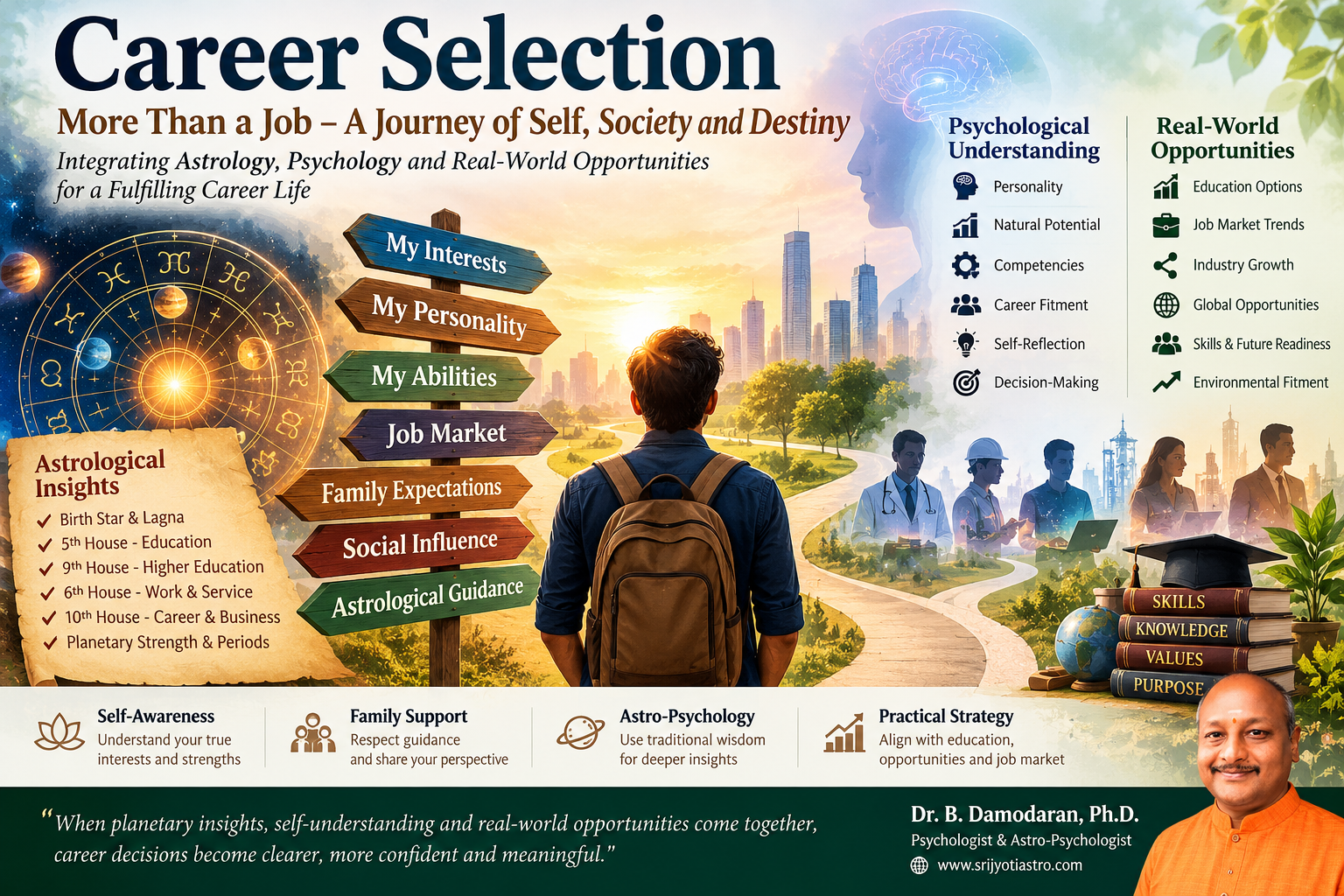
“A meaningful career is not simply what society expects us to become. It is a thoughtful alignment of who we are, what we can become, and where opportunities exist.”
1. Introduction: Who Is Really Choosing Your Career?
Career selection is one of the most important decisions in an individual’s life. It influences not only income and professional status but also personal identity, lifestyle, satisfaction, family life and long-term wellbeing.
Ideally, career selection should be a conscious and personal decision based on interests, personality, natural abilities, competencies, aspirations and opportunities. Yet in Indian society, career decisions are rarely made in isolation. Parents, relatives, teachers, peers, social expectations and increasingly social media influence students and young professionals.
A student may wish to pursue psychology, literature, agriculture, design or entrepreneurship but may be encouraged to select engineering, medicine or information technology due to expectations about prestige and security. Another may become attracted to entrepreneurship or a glamorous profession after repeated exposure to social-media success stories.
“Am I choosing my career because it genuinely reflects my interests and abilities, or am I unconsciously choosing what others expect me to become?”
Recognising the difference is the first step towards meaningful career planning.
2. The Psychological Foundations of Career Selection
Personality: Understanding who we are
Personality refers to relatively enduring patterns of thinking, feeling and behaving. It influences how individuals approach work, relationships, uncertainty and problem-solving. Some people enjoy independent research and analysis; others prefer teaching, counselling, leadership, communication or creative expression. This helps explain why people with similar qualifications may experience different levels of job satisfaction.
John Holland’s RIASEC framework identifies six broad vocational interest themes: Realistic, Investigative, Artistic, Social, Enterprising and Conventional. These themes help explore relationships between interests and occupational environments, but no person should be reduced to one category.
Natural potential: Recognising emerging strengths
Individuals develop distinct patterns of abilities in numerical reasoning, verbal expression, creativity, spatial understanding, social sensitivity and practical problem-solving. Childhood interests can provide opportunities for exploration, but they are not fixed predictions of a future occupation. Natural abilities provide a starting point; education, practice and experience develop competencies.
Competencies: From potential to performance
Interest alone does not ensure professional readiness. Someone attracted to medicine must acquire appropriate knowledge, skills, ethics and qualifications. Someone interested in entrepreneurship needs communication, financial literacy and market knowledge.
What am I genuinely interested in?
Which abilities and competencies do I possess—or have the potential to develop?
What knowledge, credentials and skills does my preferred career require?
3. Parents, Peers and Social Media: Influence or Interference?
Family influence can be constructive: parents provide resources, educational access and practical guidance. Problems arise when guidance becomes control. Parents may insist on prestigious occupations even when a young person’s motivations and aptitudes point elsewhere.
Peer choices can create pressure to enter particular courses. Social media highlights exceptional salaries, glamorous lifestyles and rapid success, potentially producing unrealistic expectations. Social comparison, conformity and fear of missing out may shape preferences, sometimes without conscious awareness.
External influences can also broaden horizons. The key is to distinguish authentic curiosity from temporary attraction, and to evaluate a career’s day-to-day tasks—not merely its reputation.
“Would I still choose this career if nobody admired its status, salary or popularity?”
4. Do We Really Need Career Counselling?
Not everyone needs intensive career counselling. Some students and professionals know their goals, demonstrate suitable abilities and understand the necessary qualifications. Nevertheless, clarity does not eliminate the possibility of discovering overlooked strengths, new pathways or future opportunities.
Career counselling may include structured interviews, interest inventories, aptitude assessments, appropriately chosen personality measures, values clarification, competency mapping and educational or labour-market research. Assessment tools should be valid, reliable and suitable for the person’s language, age and cultural background.
Career counselling is not about handing over a decision to an expert. Its purpose is to strengthen the individual’s ability to make informed decisions.
5. Astrology and Career Guidance in Indian Traditions
Astrology has long been consulted in India during discussions about education, employment, business and major life transitions. For families who value Vedic astrology, a birth chart can offer a traditional symbolic framework for personal reflection. It should not be presented as a scientifically validated method of predicting aptitude or career success.
Traditional astrological factors discussed in career consultation
| Factor | Traditional interpretation |
|---|---|
| Lagna and Lagna lord | General life orientation and individual tendencies |
| Birth star / Nakshatra | Traditional descriptions of temperament |
| 5th house | Education, learning and intellectual expression |
| 9th house | Higher learning, philosophy and life direction |
| 6th house | Service, work routines, employment and competition |
| 10th house | Profession, career and public responsibilities |
| Planetary strength | Traditional assessments of planetary influence |
| Dasha–Bhukti | Symbolic interpretation of life periods and transitions |
In some traditions, the second and eleventh houses are also considered in discussions of income and gains. Mercury may symbolise communication, Jupiter knowledge, Mars initiative, and Saturn persistence. Such associations are traditional interpretations, not psychometric findings.
A thoughtful consultation should stimulate questions and informed exploration rather than prescribe a single “destined” occupation.
6. Luck, Belief and Psychological Agency
Ideas about luck, fate and planetary timing remain meaningful in many Indian families. Psychology adds an important observation: beliefs can affect motivation, confidence, persistence and behaviour. A person who expects that progress is possible may be more prepared to train, network and apply for opportunities.
Belief alone does not secure a job or guarantee success. Outcomes also depend on qualifications, resources, competition, economic conditions and chance. Positive beliefs may support action, but unquestioning reliance on predictions can encourage passivity or anxiety.
“Hope can motivate effort, but preparation converts opportunity into action.”
7. Three Reflections: A Proposed Astro-Psychology Career Guidance Model
I propose bringing three perspectives into conversation: Planetary Reflection, Self-Reflection and Job-Market Reflection. Their roles should be differentiated: the first is traditional and optional, while the latter two rely on observable information and informed assessment.
Reflection 1 — Planetary Reflection
For people who value Jyotisha, discussion of Nakshatra, Lagna, the educational and occupational houses, planetary strength and Dasha periods may provide a culturally meaningful occasion to reflect on life decisions. Such interpretation should never be used to impose a fixed identity or abandon an otherwise suitable field.
Reflection 2 — Self-Reflection
Psychological exploration reviews interests, personality, aptitudes, values, emotional strengths, competencies and ambitions. Someone interested in psychology, for example, might examine their motivation for understanding behaviour, research, teaching, counselling and analytical work.
Reflection 3 — Job-Market Reflection
Career choices must also fit actual educational pathways, professional accreditation, training costs, employment conditions, market demand, skill requirements, salary realities and alternate routes. An interest in artificial intelligence, for example, needs realistic exploration of mathematics, programming and data skills.
“The goal is not to choose a fashionable career; it is to identify a direction where meaningful interests, developing strengths and realistic opportunities meet.”
Note: This three-reflection approach is a proposed educational framework and has not been empirically validated as a predictive assessment model.
8. Parents as Partners in Career Decisions
Parents can ask children which subjects they enjoy, what they have tried, what tasks engage them and what abilities others have noticed. They can offer experience while recognising that interests and occupational opportunities differ across generations.
When parent and child disagree, an independent counselling session may help clarify expectations and gather evidence. Families who wish to discuss astrology may do so as a voluntary cultural reflection, never as a replacement for the young person’s informed preferences and actual abilities.
Effective guidance combines the child’s aspirations, the family’s practical concerns and the realities of education and employment. Parental support should empower, not take ownership away from the individual.
9. Career Planning Is an Ongoing Process
A career choice at 16, 18 or 21 need not determine an entire lifetime. People gain new skills, change values, assume new responsibilities and encounter evolving labour markets. Engineers may become managers or teachers; professionals may move into research, entrepreneurship or counselling.
Donald Super’s life-span approach recognises that vocational identity and career roles continue to develop over time. Periodic reassessment is valuable even for high-achieving, confident professionals. A career change may reflect growth rather than failure.
10. Six Questions for Career Clarity
1. Which subjects, activities or problems genuinely interest me, even without external recognition?
2. What abilities have I demonstrated through study, work, practice or feedback?
3. How much of my ambition comes from my own interests versus parents, peers or social media?
4. What matters most in my career: learning, stability, income, service, creativity, autonomy or leadership?
5. What qualifications, skills and employment opportunities exist in my preferred field?
6. What practical step can I take to test whether this career suits me?
These questions are for educational self-reflection; they are not a diagnostic or standardised psychological test.
11. Conclusion: From External Influence to Inner Clarity
Career development is more than a degree, job title or salary. It involves discovering potential, developing competencies and contributing meaningfully through work. Vedic astrology can be a traditional and optional source of symbolic reflection for those who value it. Psychology can help explain interests, personality, abilities and motivations, while labour-market research brings concrete information about viable pathways.
A person with a clear ambition may not require extensive counselling, yet even successful professionals can benefit from a new perspective. Parents can support children through discussion, respect for autonomy and attention to practical opportunities.
The most useful career guidance keeps the individual at the centre, respects family wisdom, distinguishes tradition from empirical assessment and supports action based on well-grounded insight.
“Your career should not be merely a reflection of society’s expectations. It should express your personality, develop your natural potential and create a meaningful place for you in the world.” — Dr. B. Damodaran, Ph.D.
About the Author
Dr. B. Damodaran, Ph.D. is a psychologist, academician and Astro-Psychology practitioner whose work explores psychology, Vedic astrology, career guidance, self-awareness and personal development. Website: www.srijyotiastro.com
References and Further Reading
Holland JL. Making Vocational Choices: A Theory of Vocational Personalities and Work Environments. 3rd ed. Psychological Assessment Resources; 1997.
Super DE. A life-span, life-space approach to career development. In: Brown D, Brooks L, editors. Career Choice and Development. 2nd ed. Jossey-Bass; 1990.
Lent RW, Brown SD, Hackett G. Toward a unifying social cognitive theory of career and academic interest, choice, and performance. Journal of Vocational Behavior. 1994;45(1):79–122. doi:10.1006/jvbe.1994.1027.
Savickas ML. Career construction theory and practice. In: Brown SD, Lent RW, editors. Career Development and Counseling: Putting Theory and Research to Work. 2nd ed. Wiley; 2013.
Editorial disclaimer: Astrological concepts are discussed as traditional interpretations, not scientifically validated methods of forecasting aptitude or career success. The proposed three-reflection model is not a standardised assessment instrument.