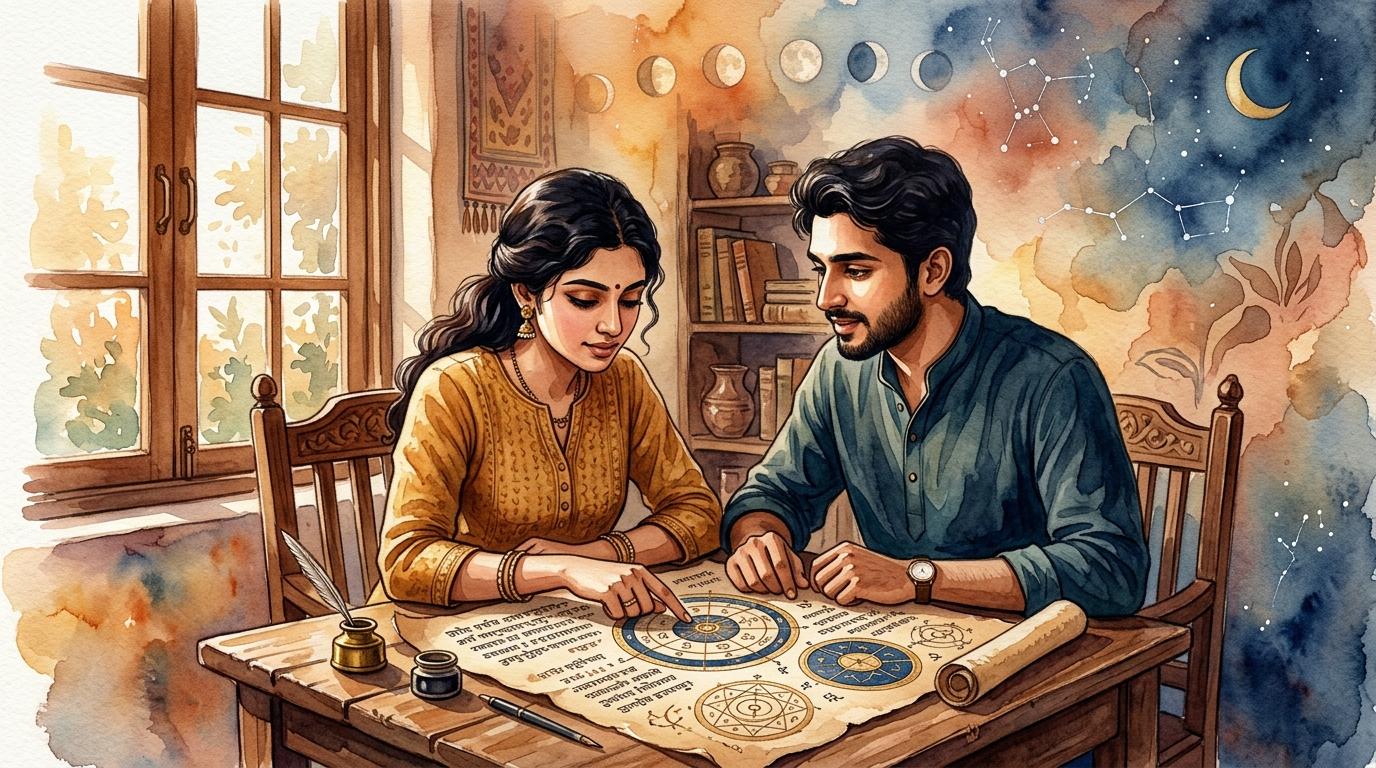
Introduction: What Really Determines Marriage?
Why do some individuals find suitable marriage partners relatively easily, while others experience repeated difficulties and delays, despite possessing good educational qualifications, financial stability, respectable social status and attractive physical features?
Is marriage determined by planetary positions in the horoscope? Is it influenced by individual personality and psychological readiness? Or does the support of parents, relatives and the family play the most important role?
These are questions that many individuals and families encounter during the process of marriage partner selection.
In Indian society, there are generally three different perspectives.
Some people strongly believe that marriage is determined by astrological factors and planetary influences. Others believe that marriage depends mainly on personal efforts, communication, clarity of expectations and practical strategies. A third group considers family background, parental involvement, social networks and community support to be the major determining factors.
My professional perspective, drawing upon my experience in psychology and traditional Vedic astrology, is that these aspects can be considered together, although they serve different purposes.
Astrology may provide a traditional framework for reflecting on marriage, while psychology, individual personality, family support, clear decision-making and effective partner-search strategies play important practical roles in finding and selecting a suitable life partner.
1. Does the Horoscope Alone Determine Marriage?
In Vedic astrology, marriage is traditionally examined through the seventh house, its lord, planetary influences, Venus, Jupiter, Navamsa and Dasha-Bhukti periods.
Many families approach an astrologer to understand questions such as:
When is marriage traditionally indicated in the horoscope?
What kind of partner characteristics are suggested by the chart?
Are there traditional indications of delay or difficulties?
How compatible are the horoscopes of two prospective partners?
What considerations should the individual and family keep in mind?
Astrology can offer a culturally meaningful framework for discussing these questions. However, horoscope interpretations are not scientifically established methods of predicting when marriage will occur or whether a relationship will succeed.
Therefore, I believe that an astrological consultation should not end with a prediction.
It should lead to greater self-reflection, clarity and practical preparation.
For instance, an astrologer may traditionally interpret certain planetary combinations as suggesting delay in marriage. Rather than creating fear or encouraging passive waiting, this discussion can become an opportunity to review the individual's expectations, partner-search methods, family involvement and psychological readiness.
The horoscope may begin the conversation, but constructive action must continue beyond it.
2. Why Do Financially and Socially Successful Individuals Experience Marriage Delays?
This is one of the most interesting questions in contemporary marriage discussions.
We frequently encounter individuals who possess:
Good educational qualifications and professional achievements.
Attractive salaries and financial security.
Respectable family and social backgrounds.
Good physical appearance.
Stable employment, property and other material resources.
Despite these advantages, some continue searching for a suitable life partner for several years.
Why?
The answer cannot always be found in financial status, family reputation, appearance or horoscope matching.
In many situations, personality characteristics, psychological expectations, communication patterns, social opportunities and decision-making processes deserve closer attention.
A professionally successful individual may find it difficult to express emotions, initiate meaningful conversations, adjust expectations or make timely relationship decisions.
Similarly, an individual may have a very narrow list of preferred partner characteristics, resulting in the rejection of potentially compatible matches.
Some families may insist upon too many conditions concerning income, profession, community, location, educational qualifications or family background.
These factors can restrict opportunities for finding a suitable partner.
However, delayed marriage should not automatically be interpreted as a personality problem. It may also reflect personal choice, limited opportunities, cultural expectations, caregiving responsibilities, economic conditions or other circumstances.
The essential question is not merely:
"What is delaying my marriage?"
It is also:
"What aspects of my expectations, approach and circumstances can I realistically understand and improve?"
3. Personality Plays an Important Role in Partner Selection
Personality is often discussed in the context of maintaining a happy marriage. But personality also influences the earlier process of finding and selecting a partner.
Psychologically, personality refers to relatively enduring patterns of thinking, feeling and behaving.
Consider two individuals who have similar educational qualifications, incomes and family backgrounds.
One communicates openly, listens attentively, respects differences and expresses expectations realistically.
The other may struggle with communication, hold rigid expectations or find it difficult to make decisions.
Their experiences during the partner-selection process may be very different.
Important psychological characteristics worth exploring include emotional maturity, self-awareness, openness, empathy, communication, flexibility, confidence and decision-making.
A person's credentials may create opportunities for marriage discussions, but interpersonal behaviour and mutual understanding influence whether those discussions develop into a meaningful relationship.
This does not mean that people must change their personalities to secure marriage. Instead, self-understanding helps individuals recognise their strengths, identify difficulties and make more informed relationship choices.
4. Marriage Expectations: The Hidden Barrier
One of the most important aspects of the marriage-search process is understanding expectations.
Individuals and families often have conscious and unconscious expectations concerning the prospective partner.
These may include education, profession, salary, family status, appearance, height, community background, horoscope compatibility, geographical location and lifestyle.
Having preferences is natural.
The difficulty arises when every preference becomes a non-negotiable condition.
For example, a prospective partner may be expected to have a particular educational qualification, earn above a specified salary, live in a preferred city, belong to a particular family background and satisfy every traditional horoscope-matching condition.
When several narrow conditions are combined, the number of potential matches can become considerably smaller.
An important psychological exercise is to classify expectations into three categories:
Essential expectations: Mutual respect, consent, emotional safety, fundamental values, life goals and important non-negotiable commitments.
Preferred expectations: Educational background, professional interests, lifestyle preferences and other desirable qualities.
Flexible expectations: Conditions that could reasonably be reconsidered following discussion and mutual understanding.
Such an exercise helps individuals and families distinguish between meaningful compatibility and unnecessary restrictions.
5. The Marriage Market: A Practical Reality
I use the expression marriage market with some hesitation because marriage is a deeply personal, emotional and social commitment. Human beings should never be viewed as commodities.
Nevertheless, the term is sometimes used in sociology and economics to describe the social environment in which prospective partners meet, evaluate compatibility and make marriage decisions.
In practical terms, the marriage-search environment includes the availability of prospective partners, social networks, geographical preferences, demographic factors, family expectations and methods of introduction.
A person's search opportunities may be limited if they depend exclusively on a small circle of relatives or only one matchmaking source.
For instance, a family might spend several years circulating the same marriage profile within a limited social network without expanding the search or reviewing repeated reasons for unsuccessful discussions.
In such circumstances, merely waiting may not improve the outcome.
A more constructive approach involves understanding the available opportunities, widening suitable networks, improving communication and reviewing expectations.
Finding a life partner requires not only identifying the kind of person one hopes to marry, but also creating appropriate opportunities to meet compatible individuals.
6. Parental and Family Support: How Important Is It?
In India, parents and relatives frequently play an active role in marriage arrangements.
Family support can be highly valuable.
Parents may contribute practical experience, introduce potential partners, provide emotional reassurance and help families discuss cultural or logistical considerations.
However, there can also be difficulties.
Sometimes the expectations of parents differ from those of the person getting married.
A family may prioritise financial status, community background or social reputation, while the prospective bride or groom may place greater importance on emotional connection, personality, professional compatibility and shared values.
When these differences are not discussed openly, the marriage-search process can become stressful or prolonged.
Therefore, family involvement should follow a principle of support rather than control.
Parents can guide, advise and assist, but the final decision must respect the informed and voluntary consent of the individuals entering the marriage.
7. Astrology, Psychology or Family Support: Which Plays the Major Role?
Instead of treating astrology, psychology and family support as competing explanations, I propose that their different functions should be clearly understood.
Astrology offers a traditional interpretive perspective.
For those who value Jyotisha, horoscope consultation can provide a culturally familiar opportunity to reflect on marital expectations, traditional compatibility considerations and personal beliefs.
Psychology provides a framework for understanding the individual.
Psychological counselling examines personality patterns, emotional readiness, relationship expectations, communication skills, interpersonal behaviour and decision-making.
Family support provides social and practical resources.
Families may assist with introductions, background discussions, logistical arrangements and emotional support, while respecting individual choice.
Strategy converts intentions into practical action.
A well-designed partner-search approach identifies realistic expectations, appropriate sources, communication methods, decision criteria and opportunities for meaningful interaction.
These functions are different. Astrological interpretations should not be treated as substitutes for reliable psychological assessment or real-world evidence about compatibility.
In practical partner selection, psychological readiness, mutual choice, available opportunities and effective action are especially important because they concern factors individuals can directly examine and influence.
8. My Proposed Integrated Marriage Guidance Approach
I suggest a five-stage approach combining traditional consultation, psychological self-understanding and practical partner-search planning.
Stage 1: Horoscope Consultation and Clarity
Individuals and families who value astrology may begin with a traditional horoscope consultation.
Its purpose should be to understand the astrological interpretation, clarify concerns and identify relevant questions for reflection.
It should not promote fear, fatalism or absolute predictions.
Stage 2: Psychological Self-Reflection
The individual should explore questions such as:
Am I emotionally ready for marriage?
What do I genuinely expect from a life partner?
What are my personality strengths and areas for development?
How effectively do I communicate with prospective partners?
Am I influenced by unrealistic expectations or fear of rejection?
Am I making my own decisions, or am I excessively influenced by others?
Counselling can support this process through structured interviews, reflection and appropriate psychological measures where indicated.
Stage 3: Family Brainstorming and Expectation Alignment
The individual and family should discuss their expectations openly.
Disagreements about education, profession, family background, geographical location, cultural practices and financial expectations should be identified.
The objective is not to eliminate all preferences but to distinguish essential requirements from negotiable ones.
Stage 4: Clear Partner-Search Strategy
A practical marriage-search strategy may include improving the marriage profile, identifying suitable matchmaking channels, expanding trusted social and professional networks, considering geographical flexibility, initiating respectful conversations and periodically reviewing whether the search approach is effective.
The process must protect privacy, dignity, honesty and consent.
Stage 5: Compatibility Assessment and Informed Decision-Making
Once a prospective partner is identified, the couple should have adequate opportunities to discuss their values, expectations and life goals.
Premarital counseling can help them explore communication, financial planning, family responsibilities, career decisions, emotional needs, personal boundaries and conflict resolution.
The final decision should reflect mutual willingness and informed understanding—not social pressure, unrealistic promises or astrological fear.
9. From Marriage Prediction to Marriage Preparation
A significant change is needed in the way individuals and families approach marriage consultations.
Traditionally, the central question is often:
"When will I get married?"
I propose that we also ask:
"How prepared am I to find, choose and build a relationship with a suitable life partner?"
This change moves the discussion from passive expectation towards active participation.
A person who believes that marriage will occur only when a favourable planetary period begins may overlook opportunities for self-development and meaningful relationship discussions.
Similarly, a family that assumes social status or financial security will automatically attract a compatible partner may neglect the importance of communication, emotional readiness and realistic expectations.
Marriage preparation should therefore involve both internal and external development.
Internal preparation includes self-awareness, emotional maturity, communication and clarity of expectations.
External preparation includes social opportunities, family cooperation, appropriate introductions and a thoughtful selection process.
10. Conclusion: Marriage Requires Clarity, Compatibility and Conscious Effort
The process of finding a life partner is complex.
Neither a favorable horoscope, nor financial prosperity, nor social reputation alone can guarantee a suitable marriage.
Horoscope consultation may offer traditional guidance for those who value astrology. Psychology can help individuals understand their personality, emotional needs, expectations and relationship behavior. Family support can create opportunities and provide reassurance. A practical strategy can make the partner-search process more organized and purposeful.
In my view, the most constructive approach is to bring these elements into a thoughtful conversation while recognizing their different roles and limitations.
Marriage should not be approached merely as an event to be predicted. It is a relationship to be prepared for, a partner to be understood and a lifelong commitment to be entered into consciously.
My Central Message
“A horoscope may offer a perspective on marriage, but personality, clarity of expectations, family understanding and a thoughtful search strategy help individuals move towards finding a suitable life partner. Marriage is not merely about waiting for the right time; it is also about preparing oneself, creating opportunities and making the right decisions.”
— Dr. B. Damodaran, Ph.D.
Psychologist & Astro-Psychologist
Sri Jyoti Astro
www.srijyotiastro.com
Disclaimer: Astrological interpretations are traditional and culturally meaningful perspectives, but they are not scientifically validated predictors of marriage timing or compatibility. Psychological counseling supports informed decisions and healthy relationships, but it cannot guarantee an outcome.